
Hair Transplant vs PRP Therapy — Which Should You Try First?
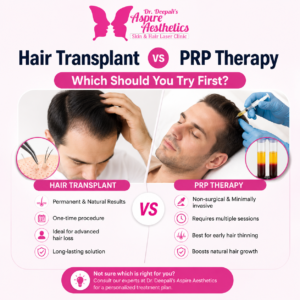
If you have been researching hair loss solutions, you have almost certainly come across two options: hair transplant and PRP therapy. Both are widely available. Both can deliver results. But they work very differently — and for very different patients.
The most common question at Aspire Aesthetics, Nagpur is: “Do I need a hair transplant, or will PRP be enough?” The honest answer depends entirely on where you are in your hair loss journey.
What Is PRP Therapy for Hair Loss?
PRP stands for Platelet-Rich Plasma. A small blood sample is drawn, processed to concentrate growth factors, and injected into thinning areas of the scalp. These growth factors stimulate weakened follicles, improve blood circulation to the scalp, and extend the active hair growth phase — helping slow hair fall and improve density over time.
The critical distinction: PRP works with follicles you already have. It cannot restore hair in areas where follicles are no longer active.
What Is a Hair Transplant?
A hair transplant is a surgical procedure where healthy follicles are harvested from a DHT-resistant donor zone — typically the back or sides of the scalp — and implanted into areas of visible thinning or baldness. The two main techniques are FUE, which leaves no linear scar and is preferred by most patients today, and FUT, which suits patients requiring a higher graft count.
Unlike PRP therapy, a hair transplant physically relocates follicles to areas where natural growth has already stopped. It is a structural solution, not a stimulation treatment.
Hair Transplant vs PRP Therapy — How Are They Different?
PRP therapy is non-surgical, involves minimal downtime, and requires multiple sessions — typically three to four initially, spaced a few weeks apart, followed by periodic maintenance. Results are gradual and usually visible around the third or fourth month.
A hair transplant is a single surgical procedure with a recovery period of around seven to fourteen days. Full results, including final density and hairline maturation, develop over ten to twelve months. The outcomes address areas where PRP therapy simply cannot help — zones where follicles are no longer present.
Who Should Start with PRP Therapy?
PRP tends to produce the best outcomes in patients who are in the early stages of hair thinning, typically Norwood Scale 1 to 3, and experiencing diffuse thinning across the scalp rather than defined bald patches. It is also a strong option for patients who want to slow or stabilise hair fall before considering surgery, or those who are not yet medically ready for a procedure.
At Aspire Aesthetics, PRP therapy is also frequently used after a hair transplant to support graft survival and protect the surrounding native hair from further thinning.
Who Should Consider a Hair Transplant Instead?
A hair transplant becomes the more appropriate solution when there are clearly visible bald areas where follicles are no longer active, when the hair loss pattern has been stable for at least a year, and when there is adequate donor density on the back or sides of the scalp. It suits patients who are looking for a long-term structural result rather than a maintenance protocol.
One important point: a transplant does not stop ongoing hair loss in non-transplanted areas. This is why many patients at Aspire Aesthetics combine surgical restoration with PRP therapy or medical management to preserve surrounding hair after the procedure.
Can You Do Both?
In many cases, yes — and it makes clinical sense. A common approach is to begin with PRP therapy to stabilise hair fall and strengthen existing follicles, proceed with a hair transplant once the loss pattern is stable, and then continue PRP post-procedure to support regrowth and long-term density. The two treatments are not competing options. They address different aspects of hair restoration and often complement each other well.
At Aspire Aesthetics, both treatments are available under one roof. The right sequence is always based on a thorough assessment of your scalp condition, Norwood stage, and overall health — not a one-size-fits-all recommendation.
So, Which Should You Try First?
If your follicles are still present but weakening, PRP therapy is the logical starting point. If you have defined bald areas with no active follicular activity, a hair transplant is the solution PRP cannot replace. And if you are genuinely unsure, a professional scalp consultation will give you that clarity in a single visit — without any commitment to treatment.
Book a consultation with Dr. Deepali Padole at Aspire Aesthetics, Nagpur.
Call / WhatsApp: +91-9209146586 | Wardha Road, Near Ajni Metro Station
FAQs
Is PRP therapy painful?
Topical numbing is applied beforehand and most patients find the procedure very tolerable. Downtime is minimal and most people return to their routine the same day or the next.
How many PRP sessions are needed to see results?
An initial course of three to four sessions spaced three to four weeks apart is typical, followed by maintenance sessions every three to six months. Results become visible gradually, usually after the second or third session.
Can PRP therapy replace a hair transplant entirely?
Not in all cases. Where follicles are no longer active, PRP cannot restore growth there. A hair transplant remains the appropriate treatment for those areas.
Is PRP effective for women experiencing hair loss?
Yes. Female pattern hair loss often involves diffuse thinning that responds well to PRP therapy, particularly when treatment begins before significant follicle damage has occurred. Aspire Aesthetics offers hair loss assessments tailored specifically to female patients.